.png)
SHARE


Editor’s note: This interview with Amancio Bouza was recorded for Coding Over Cocktails - a podcast by Lonti previously known as Toro Cloud.
Digital transformation allows organisations to adjust to new technologies and take advantage of their benefits in order to build business value. However, the road to digital transformation requires not only a technological change, but a cultural one as well.
Requiring a change in technologies, processes, and manpower, the road to transformation could get overwhelmingly complex along the way.
This is why attempts at digital transformation for many organisations could be prone to failure. And according to Amancio Bouza, API thought leader and author of "The Blockers and Catalysts of Digital Transformation", it’s more than the technology. The journey towards digital transformation is not achieved overnight.
"It's not about just setting up the new technologies that are out there to leverage these benefits, but it's really about the transformation of the identity of the organisation," he shares during an episode of Coding Over Cocktails.
Couchbase surveyed 450 C-suite executives in the US, UK, France and Germany in 2019 on how their organisations are doing on their journey towards digital transformation. A majority of them report hitting failures, major delays, and some lowered expectations on their digital transformation projects, making up 81% of the respondents. Forty-two (42%) said they were falling behind schedules or were at risk of being so with their most important digital transformation projects.
On the other hand, 73% say they would talk about the huge potential their projects could have had but fell short of being something truly innovative once deployed. This percentage however, was a safe drop from 2018’s 80% and 2017’s 90%, meaning more and more business organisations are starting to find their way around their digital transformation projects. All 73% of the respondents also agreed that digital innovation made drastic improvements to their end-user experience - a rise from 64% in 2018 and 52% in 2017.
Specific benefits that came about because of digital transformation were also named in the survey, with efficiency in working being the top benefit pointed out by 58% of the respondents. Improved customer experience and better work productivity were each recognised by 50%.
Although potential failures lurk around the corner when working on digital transformation projects, enterprises are still taking the risk. Digital transformation is a challenge that IT leaders are willing to take on not only because of the tech benefits but also because of the impact it will have on their organisations as the new generation of workers in the digital age come in.
In the survey, 40% say that one of the factors that get in the way of digital transformation is the complexity of technologies. Thirty-two (32%) responded with the lack of resources while 30% pointed to the lack of skills. Thirty (30%) say that their reliance on legacy technology also keeps them from pursuing digital transformation. Other challenges mentioned by the respondents include the lack of budget and the notion that the risk of failure was high.
However, there are also risks if an enterprise decides not to pursue their digital transformation projects. Among the respondents, a whopping 87% said they felt at risk if they fail to innovate digitally. Forty six percent (46%) raised their concerns about staying relevant in the market if they were not able to move forward with their projects. Loss of staff was also a risk among the respondents, with 42% fearing they might lose their IT employees to more innovative competitors, and 32% on losing employees in other areas of their operations.
But is integrating technologies the biggest challenge during the process of digital transformation?
Bouza disagrees.
"[The big challenge] is really changing the behaviours, about how to use this technology, how to collaborate, how to bring developers, the IT together with the business and really understanding the customer needs."
Experts at Gartner echo the same sentiment, and identified six factors that are keeping an organization from becoming a digital business and what can be done to resolve and overcome them:
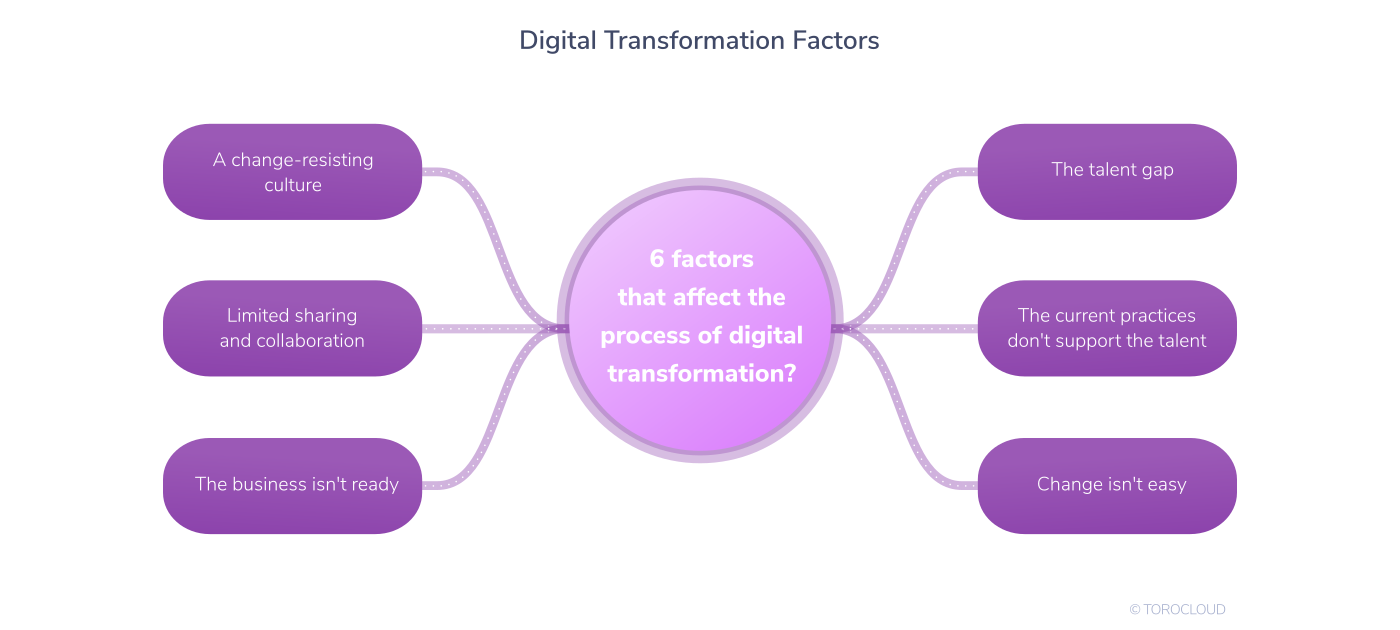

Digital transformation penetrates all parts and processes of the business. Thus, digital technology is integrated into all business operations. People and machines work in a blended environment. Therefore, organisations must set clear-cut benchmarks and understanding of issues to make all of this work effectively.
Bouza emphasises that digital transformation isn’t just about incorporating new technologies and automating business processes but it’s about changing the behaviours of the organisation towards using these technologies. He calls for a cultural change in order to properly execute a digital transformation strategy in an organisation.
"Just imagine a caterpillar [as companies], and all the companies think ‘let’s eat more and get bigger!’ then you are just becoming a bigger caterpillar. Digital transformation is really about going into a cocoon, and transforming the identity of the organisation, of what you are able to do." He adds that a digital transformation strategy can’t be dictated from a top-down management. Rather, it needs to be a collaborative approach to learning what the market and its stakeholders involved in the project need.
And businesses are doing their best to keep up with digital technologies and be at least a step ahead of their competitors. Toro Cloud founder and CEO David Brown also shares how it’s important that an organisation appreciates and takes into consideration their customers’ and business partners’ who are also likely going into a digital transformation journey of their own.
"Successful companies will help facilitate the digital transformation of not only themselves but that of their customers and business partners by evolving to the way they would like to conduct business in the future," Brown says.
You can catch more of our great discussion about embarking on a digital transformation journey during the new normal with Amancio Bouza by listening to this episode of Coding over Cocktails, a podcast by Toro Cloud.
Coding Over Cocktails is a podcast created by Lonti previously known as Toro Cloud, a company that offers a low-code, API centric platform for application development & integration.
This podcast series tackles issues faced by enterprises as they manage the process of digital transformation, application integration, low-code application development, data management, and business process automation. It’s available for streaming in most major podcast platforms, including Spotify, Apple, Google Podcasts, SoundCloud, and Stitcher.