.png)
SHARE


When asked about “automation”, the first thing that often comes to mind for most people is robotics.
This isn’t necessarily the case for the information age today. Since the 1900s, we’ve seen automation's role evolve from the use of keyboards and telephones, to its more modern application of business process automation – where companies leverage technology and artificial intelligence tools to process massive amounts of data in multiple platforms and formats.
In 2021, the business process automation market is expected to reach 12.7 billion dollars globally with growth driven by Digital Transformation initiatives of modern enterprises.
Business process automation (BPA), is the process of automating recurring business processes through the use of software and other applications. One of its primary goals is to free up employees from doing menial tasks. Other than this, BPA allows organisations to go beyond traditional data management and use advanced software systems and programs to integrate all applications.
Sometimes, BPA is also referred to as information technology process automation (ITPA). However, the more important point to understand is that BPA or ITPA do not necessarily refer to industrial automation or robotics.
The focus of BPA is to automate workflows and processes. In common BPA practice, processes within organisations and businesses are automated, and then these processes are analysed and optimised until the desired end result has been achieved.
Organisations use BPAs to reduce the time required to move tasks from one business unit to another, increase the transparency of workflows between different departments, and better adhere to technical and legal compliance standards.
Business process automation (BPA) is the strategic utilisation of technology for organising systems and personnel.
In BPA, processes represent sets of activities related to the business which can be automated to achieve the desired effect. BPA can be associated with processes from normal data management to advanced systems integration across the enterprise. With this automation practice, an organisation can control various programs like customer relationships, sales, planning, analytics, development, and more.
Using BPA, an organisation can cut down operational costs, support its employees with better technologies, and free up resources from performing low-level tasks. It reduces the turnaround time of operations, making customers happy as they can be helped immediately, while also reducing or completely eliminating human error. BPA can significantly improve decision making and human interaction whilst creating real-time transparency.
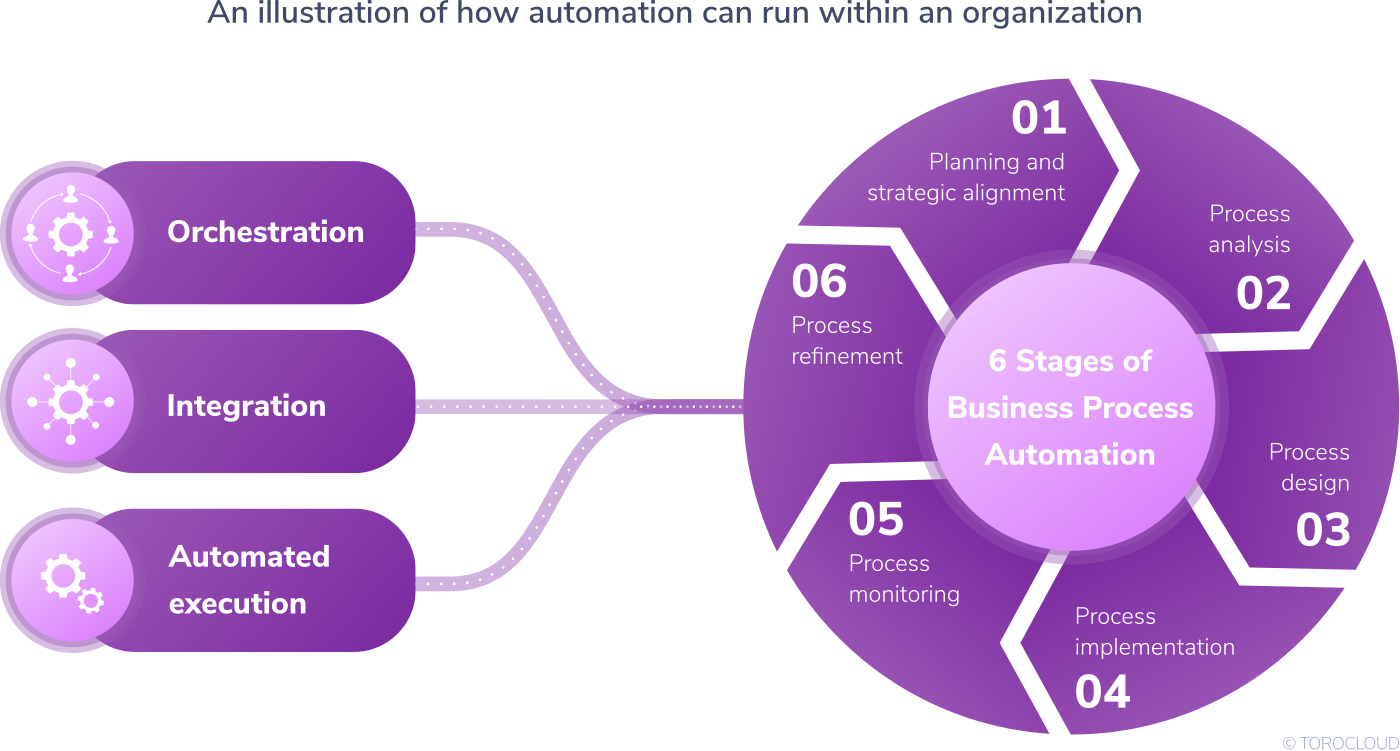
These are three principles of BPA:
Business Process Management has six stages:
Automation can be traced back to Ancient Greece with the use of automatons for toys, fountains, crossbows, gates, and a number of war machines that operate with levers, pulleys, and wheels for self-directed machinery. The automation concept was also present early in the manufacturing industry, but the most significant utilisation was in 1931, when Henry Ford began using automation to produce the signature Model T cars.
With automation, Ford was able to revolutionise the production process in the automotive industry with the first moving assembly line for mass production. This made a radical change in the way people worked, establishing America as an industrial powerhouse, paving the way for American middle class, and enabling workers to refine their individual skill sets while delivering substantial cost savings for businesses.
As technology progressed in the 1970s and 1980s, companies began using computers for basic automation. Redundant tasks and processes were eventually delegated to machines. As a result, human resources gained an opportunity to be more productive and creative in high-level jobs, and the risk of human error was mitigated.
This shift allowed BPA to become a staple for organisations wishing to achieve process excellence with continuous improvement. BPAs would often include several components such as enterprise resource planning (ERP), systems integration, and workflow tools.
Additionally, the Internet of Things (IoT) concept allowed for systems, objects, and components to connect to the digital world. In this context, BPA can facilitate data transfer over a network without any human interaction. Similarly, with the advancement in mobile technology, BPA can enable an organisation to manage a remote workforce, significantly reducing a company’s expenses.
Here are some compelling reasons why you should automate your business processes.
Apart from minimising human errors and mapping out tasks using an intuitive interface, automating business processes can be seen as tools that help reduce work-related incidents of stress.
For example, in an office management system, self-automating activities can reduce worries about missed emails or leaves. Some of the advantages of automating business processes are:
Because of the advantages it offers, the 2020s are now seen by many experts to be the decade of process automation, where the world will see more workplace transformations, more digital maturity, and more decisions made based on process automation strategies.
Does signing up for a business process automation tool solve all your problems at once? Probably not. Like in every other practice, organisations can get some inspiration and follow some of the industry’s best practices to achieve the best results.
Here are some guidelines on how organisations can achieve success from automation.
As organizations become more familiar with BPA and start working with one, it is important to identify workflows.
Workflows represent orchestrated and repeatable patterns of business activity. These are visual diagrams that allow businesses to automate their processes – usually with the goal of reducing processing time in production, increasing efficiency, and providing more consistency.
There is a wide availability of workflow automation software that can help you in business process automation such as Martini, Pega, Oracle SOA Suite, TIBCO, etc. Using these platforms, an organisation can build workflow diagrams by providing inputs, outputs, and business rules with the logic of how the system behaves. It acts as a workflow management system that allows businesses to reorganise and tweak the workflows over time.
A workflow engine manages and monitors the activities and its states in a workflow. It helps organisations coordinate and facilitate the business processes. This is also known as an orchestration engine. The engine sets a time for each activity so that the whole process becomes faster.
Imagine a process that goes through a certain number of departments and people in order to be completed. So, it can take time and resources since the information has to flow through everybody. Hence, if not automated, it will cost both money and resources.
Workflow management coordinates the tasks that build the work an organisation does. As previously discussed, the term ‘workflow’ signifies a sequence of tasks that are part of some larger task, or 'business process.' While creating a workflow aims to achieve some results, workflow management aims to achieve better results per the set goals. In workflow management, software tools are used to keep track of the work and to automate parts of it.
In workflow management, the tasks can be automated and performed by IT systems. Hence, workflow management includes IT systems integration. This helps share data between workflows and other IT systems within an organisation. This is why workflow management is considered as a management discipline and not just a software process.
A workflow management system (WFMS) automates the parts of management coordination which are common to different workflows. It is a general-purpose tool that potentially supports any workflow.
Toro Cloud’s iPaaS platform, Martini, is a low-code API centric solution that facilitates application and system integration, and event-based workflows for orchestrating business processes. Being low-code, there is no need to write repetitive and laborious cookie-cutter code to create workflows, build integration services, consume or publish APIs, transform data, log transactions, or create reports. Workflows, integrations and APIs are all represented graphically enabling developers and business users to collaborate on business process automation tasks.
Business process automation is to the digital transformation revolution, the same way that robotic automation was to the industrial revolution. BPA results in greater transparency of processes and improves operational efficiency that can result in reduced costs, improved employee productivity, and customer satisfaction. Like robotics, business process automation may initially be seen as a threat to the stability of an employee’s position. However, instead of a threat, it provides opportunities for employees to concentrate on less mundane, higher-value tasks such as business development and other activities that contribute to enterprise value.
Coding Over Cocktails is a podcast created by Lonti previously known as Toro Cloud, a company that offers a low-code, API centric platform for application development & integration.
This podcast series tackles issues faced by enterprises as they manage the process of digital transformation, application integration, low-code application development, data management, and business process automation. It’s available for streaming in most major podcast platforms, including Spotify, Apple, Google Podcasts, SoundCloud, and Stitcher.